Measuring the Speed of Light: A Deep Dive into Fiber Optics and Time-of-Flight
An in-depth analysis of light propagation in multi-mode fibers, covering refractive indices, group velocity, and the impact of modal dispersion.
Measuring the Speed of Light: A Deep Dive into Fiber Optics
In my Modern Physics Lab at Marmara University we recently tackled one of the most fundamental constants in physics: the speed of light (). While m/s in a vacuum the reality inside a dense medium like an optical fiber is far more complex and interesting.
The Theory: Phase vs. Group Velocity
In a medium light interacts with the atomic structure slowing it down. This is typically described by the refractive index (). However since we are measuring a pulse of light (an envelope of many frequencies) we aren't measuring the phase velocity but the group velocity ():
For pure fused silica the group index is usually between and . In our experiment we aimed to determine this value experimentally using a Time-of-Flight (ToF) spectroscopy technique.
Experimental Methodology: Eliminating Latency
Measuring nanosecond delays requires extreme precision. The main challenge is that our equipment (LEDs photodetectors and BNC cables) introduces its own internal latency ().
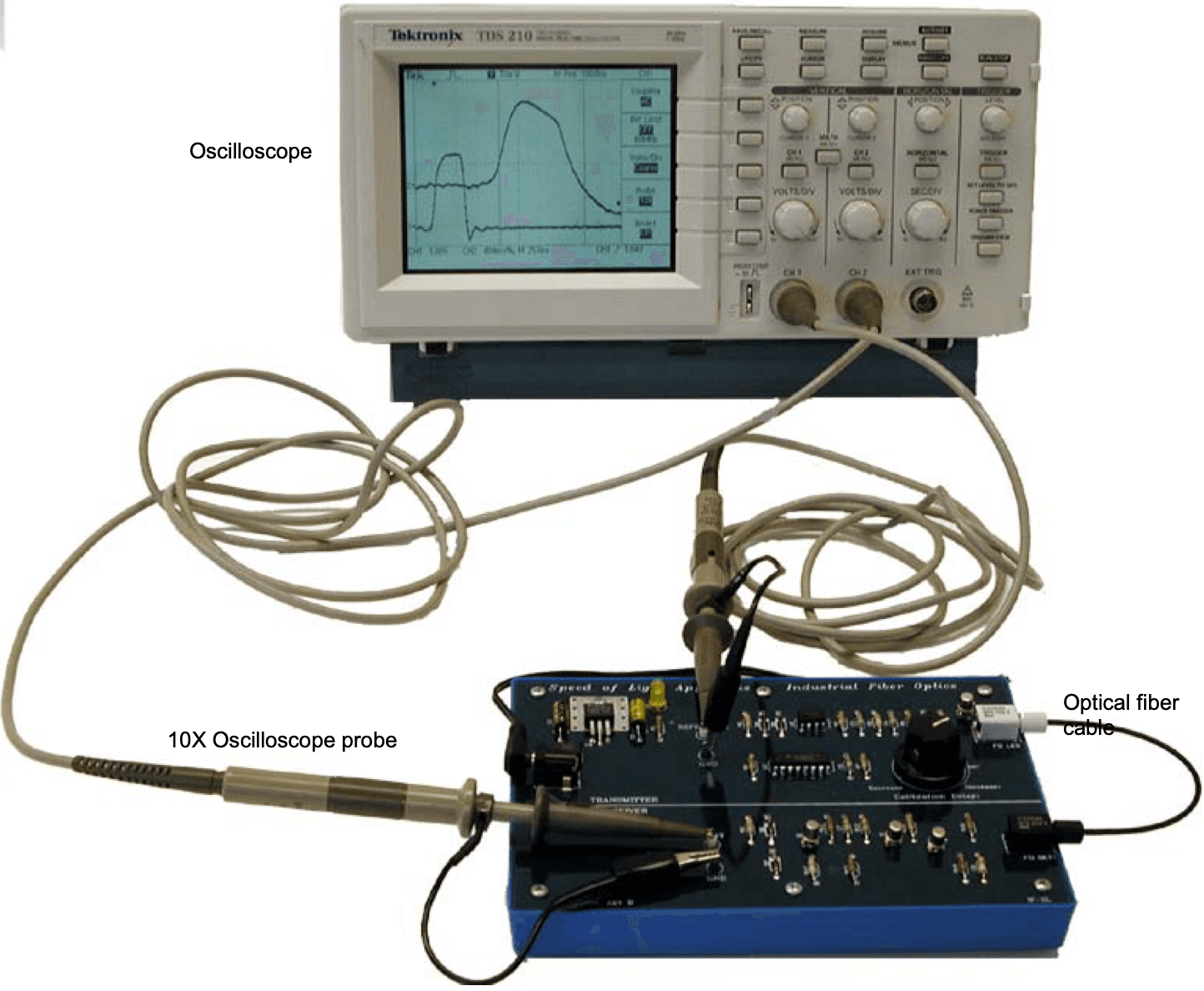
To isolate the signal transit time we employed a Differential Measurement Technique. We compared two different fiber lengths:
- Reference Length (): 30 cm
- Primary Length (): 18.9 meters
By subtracting the two results the system latency cancels out perfectly leaving us with the net additional distance: .
Analysis of Results
Using a Digital Storage Oscilloscope (DSO) we observed a temporal shift of ~ns.
1. Velocity and Refractive Index
Plugging our measured values into the velocity equation:
This yields an experimental refractive index of .
2. The Velocity Factor (VF)
A key metric in telecommunications is the Velocity Factor defined as . In our case: This means light was traveling at 62% of its vacuum speed through our fiber.
Discussion: Why the 10.3% Deviation?
The accepted value for silica is . Our value of represents a 10.3% error. In physics the "why" is often more important than the result itself. We identified three major systematic factors:
A. Modal Dispersion and Effective Path Length
Our cable was a multi-mode plastic-clad silica fiber. In multi-mode fibers light follows "zigzag" trajectories. While the physical cable is 18.6m the actual path taken by the light modes is longer. Since we triggered our measurement at the half-maximum point of the pulse we were likely detecting modes that had traveled a significantly longer distance thus inflating our .
B. Pulse Broadening and Attenuation
As we switched from the 30cm to the 18.9m fiber we observed two things:
- The signal amplitude decreased (Attenuation).
- The pulse width increased (Broadening).
This is due to Rayleigh Scattering and Material Absorption. The broader pulse makes the "half-maximum" point harder to pin down precisely introducing trigger ambiguity.
Oscilloscope Resolution: Our DSO was set to 50 ns/div. A human error of just 8 ns in cursor placement—hardly a few millimeters on the screen—is enough to account for the entire 10% discrepancy.
Conclusion
This experiment was a practical demonstration of the limitations of high-speed data transmission. While the theoretical speed of light is a constant the effective speed is a slave to waveguide geometry and material properties. For a physics student and developer it’s a reminder that between the code (data) and the hardware (fiber) there's a lot of beautiful messy physics happening.
Technical Specs of the Lab:
- Source: Pulsed LED/Laser
- Fiber Type: Multi-mode Plastic-Clad Silica (PCS)
- Equipment: Digital Storage Oscilloscope (DSO), BNC Interconnects.
References
- Goree, J. A. (2002). Experiment S1: Speed of Light – Time of Flight Method. University of Iowa Physics Laboratory Manual.
- Agrawal, G. P. (2002). Fiber-Optic Communication Systems (3rd ed.). Wiley-Interscience.
- Mohr, P. J., Newell, D. B., & Taylor, B. N. (2018). CODATA Recommended Values of the Fundamental Physical Constants. NIST.
- Hecht, E. (2017). Optics (5th ed.). Pearson.
- Born, M., & Wolf, E. (1999). Principles of Optics (7th ed.). Cambridge University Press.
- Senior, J. M., & Jamro, M. Y. (2009). Optical Fiber Communications: Principles and Practice. Pearson.
- Einstein, A. (1905). Zur Elektrodynamik bewegter Körper. Annalen der Physik.